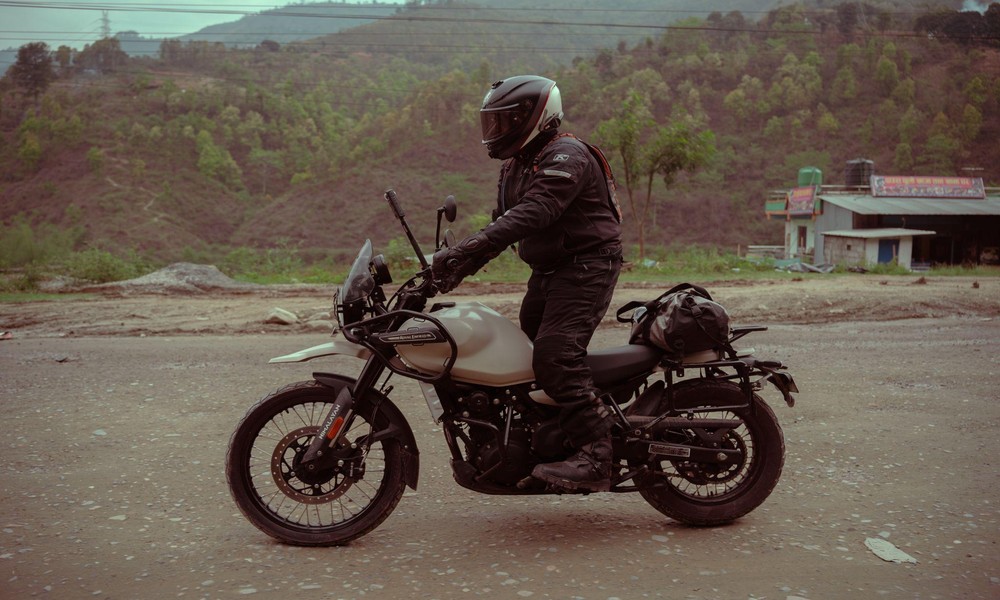

Pull into any tea house between Besisahar and Manang on the Annapurna Circuit, or park outside a guesthouse in Muktinath after the Thorong La climb, and you will notice something striking about the bikes lined up outside. Royal Enfield Himalayans. Almost exclusively. A handful of locally modified Chinese 150cc commuters, perhaps one or two KTM Adventures belonging to foreign tourers, and then row after row of Himalayans, dusty, loaded, utterly at home.
This is not coincidence, and it is not brand loyalty in the sentimental sense. Nepal’s mountain roads are among the most technically demanding riding environments on earth, and the Royal Enfield Himalayan has earned its dominance there through a specific combination of qualities that no competitor at its price point currently matches. This article breaks down exactly why.
The Terrain Problem That Every Nepal Bike Must Solve
Before examining the Himalayan specifically, it helps to understand what Nepal’s mountain roads actually demand from a motorcycle. The popular image, dramatic switchbacks with a mountain backdrop, undersells the reality considerably.
Nepal’s high-altitude routes combine unpaved gravel and rock sections, river crossings with no bridges, clay surfaces that become near-frictionless in rain, altitude ranging from 800 to over 5,000 metres, fuel stations separated by distances that would be considered remote in most countries, and mechanical support that effectively ends above certain elevations. The Mustang district, the Dolpo region, the roads above Namche Bazaar, these are not routes that forgive a bike poorly suited to the environment.
Any motorcycle that dominates this terrain must answer five questions convincingly: Can it handle the surface? Can it handle the altitude? Can it be fixed when it breaks? Can riders find parts? And critically, can most Nepali riders, who are not wealthy by global standards, actually afford to own and run one?
The Royal Enfield Himalayan answers all five better than anything else currently available in the Nepali market.
Purpose-Built Ground Clearance and Suspension Travel
The Royal Enfield Himalayan carries 220mm of ground clearance – meaningfully higher than the Honda CB500X (150mm), the KTM 390 Adventure (200mm), and most parallel contenders. On Nepal’s broken high-altitude tracks, where a rock shelf or embedded boulder in the middle of the road is a routine hazard rather than an exception, those extra millimetres translate directly into fewer catastrophic impacts on the undercarriage and exhaust.
Suspension travel is equally important. The Himalayan offers 200mm front fork travel and 180mm rear figures that sit solidly in adventure-touring territory and absorb the continuous low-frequency punishment of corrugated dirt tracks without transferring all of it to the rider. On a full day of riding between Kagbeni and Lo Manthang in Upper Mustang, the difference between adequate suspension travel and insufficient suspension travel is the difference between arriving functional and arriving destroyed.
Why the KTM 390 Adventure Loses Here
The KTM 390 Adventure is objectively a more sophisticated motorcycle – WP suspension, cornering ABS, more power. On European gravel roads or well-maintained adventure touring tracks, it outperforms the Himalayan in almost every measurable category. On Nepal’s specific combination of deep gravel, sharp rocks, river sand, and altitude, it has two critical vulnerabilities: it is electronically complex in an environment where electronic faults cannot be diagnosed or repaired, and its relatively high seat height and aggressive ergonomics punish riders on very slow technical terrain for extended periods. Whether it is Manang or Mustang motorbike tour, Nepali riders report the Himalayan as dramatically more manageable on the specific terrain they actually ride.
The Altitude Advantage: A Carbureted Engine in a High-Altitude World
This is the most technically significant reason for the Himalayan’s dominance, and the one most frequently overlooked by reviewers writing from sea-level perspectives.
The BS4 Royal Enfield Himalayan – still the predominant version on Nepal’s roads – uses a carbureted 411cc single-cylinder engine. The BS6 version uses fuel injection. Both perform adequately at altitude. But in the context of Nepal’s riding environment, the carbureted version offers something that fuel-injected competitors categorically cannot: the ability to be tuned for altitude by any competent mechanic using tools available in a village.
At 4,500 metres above sea level, air is thin. Fuel injection systems compensate automatically through oxygen sensors and ECU adjustments – until they malfunction, at which point you need a diagnostic laptop and a dealership. A carburetor running rich at altitude can be leaned out by a mechanically literate rider with a screwdriver in twenty minutes. This is not a hypothetical advantage. It is a practical reality that Nepali riders, guides, and expedition operators cite consistently as the deciding factor when choosing a fleet motorcycle.
Fuel Consumption at Altitude
The Himalayan’s 411cc single returns approximately 30-35 kilometres per litre under real mountain conditions – loaded, at altitude, on mixed terrain. With a 15-litre tank, this gives a realistic range of around 400 kilometres between full tanks. On Nepali mountain routes where fuel stations are sometimes 150 kilometres apart at elevations where fuel itself is scarce and expensive, this combination of economy and range is genuinely strategic rather than merely convenient.
Repairability: The Factor That Actually Decides Fleet Purchases
Ask any motorcycle tour agency in Nepal why their fleet is predominantly Royal Enfield Himalayans, and the answer comes quickly and consistently: parts availability and mechanic familiarity.
Royal Enfield has operated in the Indian subcontinent for over a century. The mechanical architecture of its single-cylinder engines, relatively simple, long-established, tolerant of imprecise maintenance is understood by a vast network of mechanics across Nepal and the border regions of India. In Beni, in Jomsom, in Dunai, there are mechanics who have been working on Royal Enfield engines for decades. The knowledge is embedded in the region in a way that applies to no other adventure motorcycle brand.
The Parts Ecosystem
Genuine Royal Enfield parts are available in Kathmandu with reasonable reliability. More importantly, compatible aftermarket components are widely stocked across the Terai and hill regions. When a Himalayan needs a new clutch cable in Tatopani, the part either exists locally or arrives from Pokhara within a day. When a KTM 390 Adventure needs a throttle body or an ABS sensor in the same location, the realistic option is to transport the bike – an exercise that can cost more than the part itself and eliminates the riding day entirely.
This parts ecosystem advantage compounds dramatically for operators running multiple bikes. A fleet manager running eight Himalayans can maintain a common parts inventory. A mixed fleet requires exponentially more stock diversity for the same coverage.
Ergonomics Built for Nepal’s Riding Posture
The Royal Enfield Himalayan’s ergonomics are frequently described by Western reviewers as “comfortable but uninspiring.” This assessment reflects a riding context where comfort means relaxed highway cruising. In Nepal, comfort means something different: the ability to maintain physical control on slow, technical terrain for eight to ten consecutive hours without the sustained tension that leads to dangerous fatigue and decision errors.
The Himalayan’s upright seating position, relatively low seat height of 800mm, wide handlebar sweep, and forward foot peg placement work together to create a riding posture that Nepali riders, many of whom are shorter in stature than the European or North American adventure rider for whom most competitors are designed, find genuinely manageable across very long days.
The bike’s 182kg kerb weight sits in a range that allows most experienced riders to manhandle it through soft river crossings and recover from low-speed falls without assistance. The KTM 390 Adventure, Honda Africa Twin, and BMW G 310 GS all ask more from a rider in terms of physical strength or height at the moments when the bike falls or needs to be repositioned at a standstill. On Nepal’s routes, those moments occur regularly.
Price, Running Costs, and the Economics of Mountain Riding
The Royal Enfield Himalayan retails in Nepal at approximately NPR 10,00,000 (roughly USD 6500 – 7000 at current exchange rates). The KTM 390 Adventure sits at approximately NPR 900,000-10,00,000. The Honda CRF300L, a competitive off-road alternative, is priced way higher to the KTM. The BMW G 310 GS comes in at over NPR 1,000,000.
For individual riders, the price gap is significant but not necessarily decisive. For trekking operators building and maintaining fleets of six to twelve bikes, it is arithmetic. The Himalayan fleet costs less to purchase, less to insure, less to maintain, and less to repair. The total cost of ownership differential over three years of commercial mountain operation is substantial enough to make the decision essentially automatic for any operator running the numbers honestly.
Running costs reinforce the purchase economics. Valve clearances on the 411cc single are straightforward to check and adjust. Oil and filter changes require no specialised tools. Brake pad replacement is accessible. The electrical system, while not sophisticated, is simple enough that fault diagnosis rarely requires anything beyond a multimeter and experience.
What the Himalayan Does Not Do Well
Intellectual honesty requires acknowledging the motorcycle’s real limitations. The Himalayan is not fast – its 411cc single produces around 24 bhp, which is adequate for mountain speeds and frankly insufficient for anyone wanting to cover distance efficiently on Nepal’s few stretches of improved highway. Vibration at sustained speeds above 80 km/h is notable and fatiguing on longer paved sections.
The BS6 fuel-injected version, now the current production model, has eliminated the carburetor advantage for new buyers – though the enormous fleet of BS4 machines already operating across Nepal means this matters less in the used market where most Nepali riders actually shop.
Build quality, while improved across successive generations, does not match Japanese or European competitors at equivalent price points in absolute terms. Owners who maintain their Himalayans properly experience few issues. Those who defer maintenance in the way that might be tolerable on a Honda discover that the Royal Enfield rewards attention and punishes neglect more sharply than the Japanese competition.
The Himalayan’s Real Competition: Patience and Understanding the Market
The Royal Enfield Himalayan does not outsell every other motorcycle on Nepal’s mountain roads because it is the best adventure motorcycle in the world. It outsells them because it is the best adventure motorcycle for Nepal’s specific mountain roads, at a price Nepali riders can access, serviced by mechanics who exist where the roads actually go.
Adventure motorcycle design optimised for European tastes and European infrastructure consistently underestimates this equation. Sophisticated electronics, high power outputs, premium suspension components, and advanced rider aids are genuine advantages on the terrain they were designed for. On a rocky river crossing above 4,000 metres in Mustang, with a broken track between you and the nearest town, the advantages that matter are simplicity, repairability, ground clearance, fuel range, and a mechanical architecture that the person holding the spanner has worked on a hundred times before.
On those criteria, at that price, nothing currently available in Nepal’s market beats the Royal Enfield Himalayan. And until something does, the tea houses of the Annapurna Circuit will keep the same view out front.